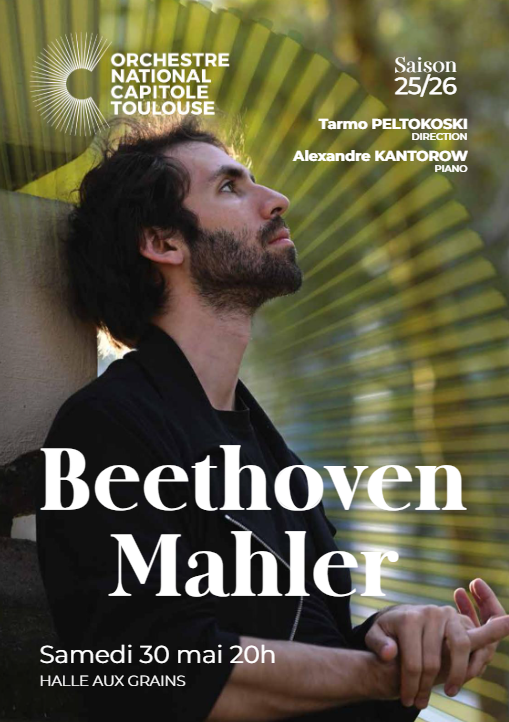
At the Halle aux Grains in Toulouse for an evening of Beethoven and Mahler with the Orchestre National de Toulouse under the baton of Tarmo Peltokoski.
The concert began with Beethoven’s Piano Concerto no. 4, with soloist Alexandre Kantorow, a French pianist who has been described by Gramophone as a “fire-breathing virtuoso with a poetic charm”. He won the first prize and gold medal at the 16th International Tchaikovsky Competition in 2019. He was also awarded the Grand Prix, an exceptional distinction only ever given three times before in the history of the competition. He reached a wider audience when, in 2024, he played at the opening ceremony of the Olympic Games in Paris. He has toured the world with concerts throughout Europe, Asia and the United States of America.
The orchestra performed the piece well, with delicacy and warmth; however, it is a composition which allows the piano soloist to really demonstrate their skills and Alexandre Kantorow certainly did that. His performance brought sustained applause and he was called back to the stage four times, finally to play an encore of Franz Liszt’s transcription of Richard Wagner’s ‘Liebestod’ from ‘Tristan and Isolde’, which he played absolutely brilliantly. He is on next season’s programme twice and I look forward very much to seeing him perform again.
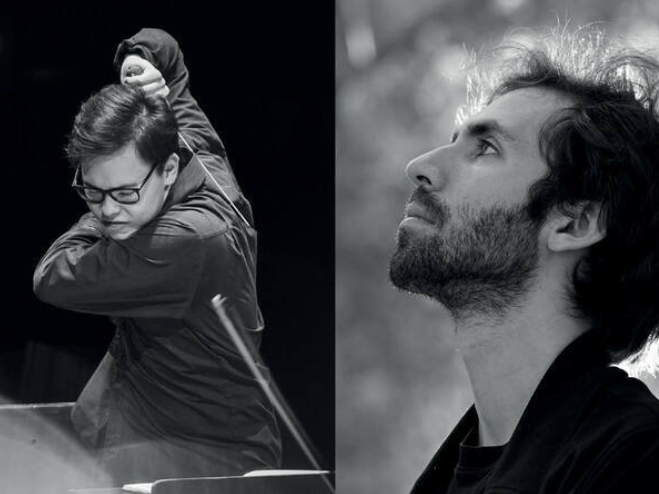
Tarmo Peltokoski and Alexandre Kantorow
The second half was a rousing rendition of Gustav Mahler’s Symphony no. 6, which I thoroughly enjoyed. The symphony was composed during an extremely happy time in Mahler’s life, as he had married Alma just a couple of years before and during the course of the work’s composition, his second daughter was born. It is something of a conundrum then why the work has gained the nickname ‘Tragic’. It is likely that it reflects Mahler’s view of the tragedy of life and, if so, it would be only a year after the Sixth Symphony’s premiere in 1906 that he would be proved right, his ultimately fatal heart ailment was diagnosed, his four-year-old daughter Maria died, and he parted company, not on the best of terms, with the Vienna Opera.
The symphony is a monumental work which features well over one hundred musicians, including large brass and woodwind sections and eight percussionists, who appeared to be enjoying themselves enormously with timpani, cymbals, triangles, cowbells, glockenspiel and xylophone and, of course, the enormous wooden block and mallet.
After a rousing opening, the inner movements were played with great feeling with some beautiful sounds from the strings, but it is the tense and driving final movement that I enjoyed the most, leading to those mighty final hammer blows of doom. It was a spectacular event to end the season.
Ludwig van Beethoven ‘Concerto for Piano and Orchestra no. 4 in G Major’, opus 58; Gustav Mahler ‘Symphony no. 6 in A Minor’.

