One of my favourite works in the chamber music repertoire is Franz Schubert’s ‘Piano Trio no. 2’, opus 100, and Trio Wanderer’s recording remains my benchmark interpretation. It was therefore a particular pleasure to hear the ensemble perform this masterpiece at the closing concert of the Musique en Périgord Festival in Les Eyzies, in the Dordogne region of France.
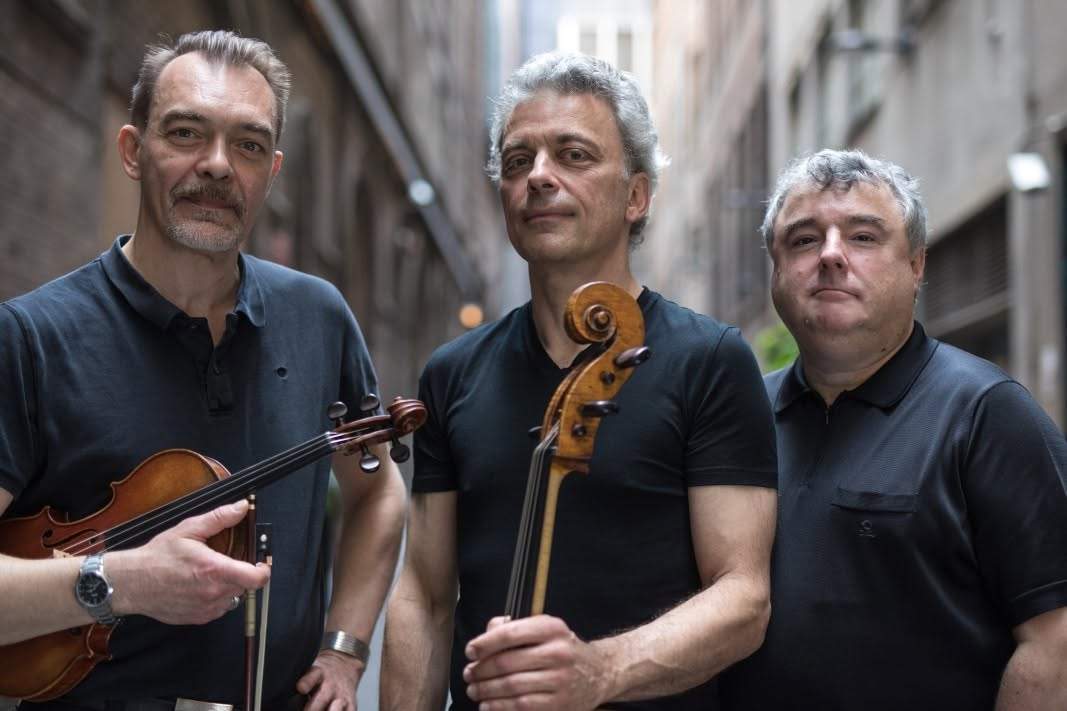
Trio Wanderer: Jean-Marc Phillips (violin), Raphaël Pidoux (cello), Vincent Coq (piano),
The programme opened with Bedřich Smetana’s ‘Piano Trio in G minor’, composed in 1855 following the death of his four-year-old daughter, Bedřiška, from scarlet fever. It is one of the composer’s most deeply personal works, and its grief-stricken character is immediately established in the haunting opening movement. Violinist Jean-Marc Phillips gave a particularly affecting account of its impassioned opening theme, capturing both its anguish and lyricism.
Although the second movement is marked as a scherzo, it is far removed from the carefree character often associated with the form. Instead, Smetana alternates moments of lightness with passages of frantic motion. The energetic finale draws on Czech dance rhythms, yet even here it combines moments of urgency with episodes of reflective calm before ending in a dramatic flourish. Trio Wanderer responded to every shift in mood with sensitivity, combining technical skill in the more demanding passages with tenderness when it was called for
The tragedy that inspired the trio was compounded when Smetana and his wife, Kateřina, soon after, lost another infant daughter just eight months after her birth, making the work’s emotional intensity all the more poignant.
After the interval came what has become the Wanderer’s signature work, Franz Schubert’s ‘Piano Trio no. 2’, completed in 1827, just a year before the composer’s death. The expansive first movement unfolds through a number of interwoven musical ideas with a succession of memorable themes and unexpected modulations. The main theme of the second movement, with its sombre, almost funeral-march character, memorably featured in Stanley Kubrick’s 1975 film ‘Barry Lyndon’, amongst others, and so is very well known. Trio Wanderer’s interpretation was beautifully judged, allowing the movement’s quiet intensity to speak without exaggeration.The scherzo is a welcome contrast, much lighter and more playful, given buoyancy by the excellent pianism of Vincent Coq, who played superbly throughout the evening. The finale is again quite complex, recalling the haunting melody of the second movement and was wonderfully played by all.
Unsurprisingly, the audience gave an extremely enthusiastic response and in return we were rewarded with two encores – excerpts from Dvořák and Haydn piano trios – which provided an excellent conclusion to a thoroughly enjoyable evening.
Bedřich Smetana: ‘Trio for piano in G minor, Opus 15; Franz Schubert: Piano Trio no. 2 in E flat major, Opus 100
 The Diary of One Who Disappeared