The annual visit to the Issigiac International Music Academy was rewarded with a concert of works from the Romantic period by Beethoven, Stanford and Brahms by the Dante Quartet. The Dante Quartet, one of the UKs finest, was founded in 1995 and has undergone several changes in personnel over the years but currently has Zoe Beyers on first violin, Ian Watson on second violin, Carol Ella on viola and Richard Jenkinson on cello.
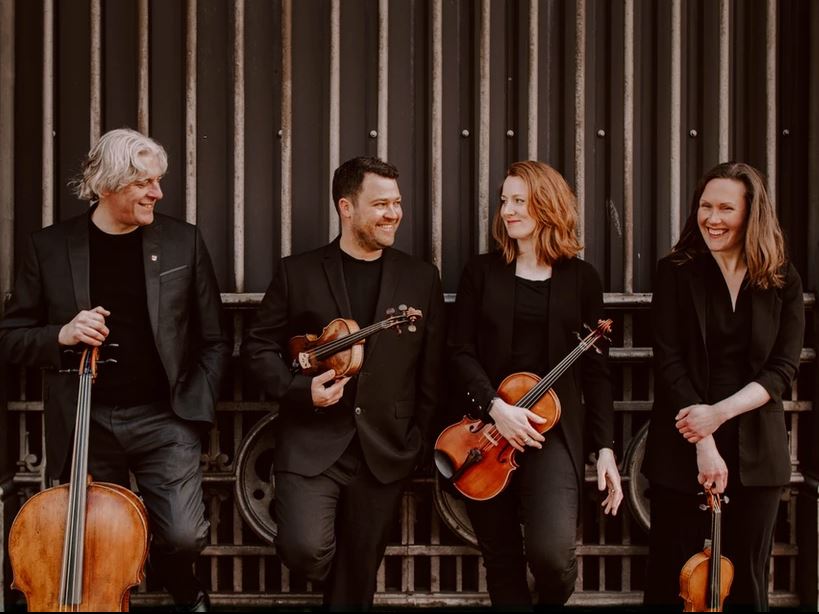
Dante Quartet
Beethoven’s late quartets are said to be the ultimate examples of string quartet music and they don’t come any later than String Quartet no. 16 in F major, which was his last completed and not performed until after his death. The opening Allegretto has an enjoyable light-hearted, almost Haydnesque, quality. Whilst the second movement, in all but name a scherzo, has the rhythms of the four parts often seemingly in conflict, the third, slow movement is more poignant. However, all is resolved in the more exuberant final movement which finishes on a happier note. The complexities of the work were handled with great aplomb by the Dantes.
Charles Villiers Stanford’s Quartet no. 5 in B flat major was new to me. It was completed in 1907 and dedicated to the memory of his close friend, the violinist, Joseph Joachim, who had recently died. However, it is by no means a gloomy work, especially the opening Allegro moderato movement which is quite energetic with a joyful Irish lilt. Whilst the second and third movements have more feeling, the final Allegro moderato, which quotes a passage from a work by Joachim, completely dispels the previous plaintive mood.
The second half of the concert was a performance of the Brahms String Quartet no. 1 in C minor. Probably because of the dominance of the Beethoven String Quartets, Brahms was slow to publish his first, doing so in 1873, after, it is said, composing and destroying twenty such works.
The first movement is quite agitated and rhythmic, whilst the middle movements are more lyrical. The third movement in particular, described as an intermezzo rather than a scherzo, has a more relaxed pace. The final movement restores the more aggressive energy of the first before coming to a triumphant resolution.
Beethoven: String Quartet no. 16 in F major, opus 135; Stanford: String Quartet no. 5 in B flat major , opus 104; Brahms: String Quartet no. 1 in C minor, opus 51.
 The Diary of One Who Disappeared